Guildess is a Contemporary Female Artist Guild. Our mission is to increase women’s involvement in the arts through exhibitions, outreach, education, and community service. Unlike guilds of the past, Guildess is an association of women involved in arts advocacy. Together, we raise awareness for women artists and expand arts programming to underserved women and children in our community.
Thanks!
Sunday, June 5, 2011
A short sabbatical..
Well here I am at my 100th post! I have been spending much of my extra time lately working on planning Guildess' upcoming year. Until we have the ball rolling on that, I will have to take a short sabbatical from my personal blog and direct readers to Guildess' page: http://guildess.wordpress.com/

Friday, April 29, 2011
Women: Superior, Yet Inferior
Compared to men, women commit fewer crimes, hold more graduate degrees, and are better long-term investors. But women earn less than men, and more women live in poverty. How long will women tolerate an inferior status?
Last week, I sat in on the filming of an episode of 4th Street Forum, "Women: Superior, Yet Inferior." The program touched upon a wide variety of topics associated with women's equality in the public and private spheres.
4th Street Forum is a nonpartisan program that promotes public discussion of political and social issues that concern our community. Each week, a panel of experts presents their views on a chosen topic and explores solutions with the audience and the 4th Street Forum moderator.
Last week, I sat in on the filming of an episode of 4th Street Forum, "Women: Superior, Yet Inferior." The program touched upon a wide variety of topics associated with women's equality in the public and private spheres.
4th Street Forum is a nonpartisan program that promotes public discussion of political and social issues that concern our community. Each week, a panel of experts presents their views on a chosen topic and explores solutions with the audience and the 4th Street Forum moderator.
Wednesday, April 13, 2011
Identity: Lorna Simpson and Vivian Maier
With the onset of spring, I have found myself incredibly busy planning future Guildess projects, starting a new residency with Artists Working in Education, and developing art programs for the Boys & Girls Clubs. However, I have still managed to find time to learn, explore, and create.
On April 2nd, a friend and I took a trip to Chicago to attend a lecture by Lorna Simpson at the Museum of Contemporary Art and view the recently discovered work of Vivian Maier at the Chicago Cultural Center. Of Simpson's entire lecture, I particularly enjoyed her comments on identity within her new series LA-57 NY-09, which draws upon an archive of photographs from the 1950s. In this body of work, Simpson creates self-portraits that mimic portraits of an unknown woman from the past. As she dresses up and poses, Simpson blurs the notion of historical identity by challenging our views of culture, history, and contemporary times.
 My questions are: How can one emulate someone's identity simply by viewing a photograph of them? What can we learn about someone through a series of self-portraits?
This brings up an interesting connection to Vivian Maier. As an avid photographer, Maier left behind 100,000 negatives, 600 undeveloped rolls of color film, and several hundred undeveloped rolls of black and white film from the 1940s and 50s. Unlike the archive of self-portraits Simpson emulates, Maier predominantly photographed her surroundings on a daily basis. To this, does one get a better sense of someone's identity through a collection of self-portraits or through a collection of photographs that they have taken of the world around them?
In my opinion, the latter of the two scenarios holds more truth. Although we can get a basic sense of the physical identity of an individual through countless photographs of themselves in simple settings, seeing the world through the "eyes" of someone else is an unmistakable reflection of who they are. After viewing a small collection of Maier's work at the Chicago Cultural Center, I can imagine her being curious, compassionate, secretly humorous, and reserved.


On April 2nd, a friend and I took a trip to Chicago to attend a lecture by Lorna Simpson at the Museum of Contemporary Art and view the recently discovered work of Vivian Maier at the Chicago Cultural Center. Of Simpson's entire lecture, I particularly enjoyed her comments on identity within her new series LA-57 NY-09, which draws upon an archive of photographs from the 1950s. In this body of work, Simpson creates self-portraits that mimic portraits of an unknown woman from the past. As she dresses up and poses, Simpson blurs the notion of historical identity by challenging our views of culture, history, and contemporary times.
This brings up an interesting connection to Vivian Maier. As an avid photographer, Maier left behind 100,000 negatives, 600 undeveloped rolls of color film, and several hundred undeveloped rolls of black and white film from the 1940s and 50s. Unlike the archive of self-portraits Simpson emulates, Maier predominantly photographed her surroundings on a daily basis. To this, does one get a better sense of someone's identity through a collection of self-portraits or through a collection of photographs that they have taken of the world around them?
In my opinion, the latter of the two scenarios holds more truth. Although we can get a basic sense of the physical identity of an individual through countless photographs of themselves in simple settings, seeing the world through the "eyes" of someone else is an unmistakable reflection of who they are. After viewing a small collection of Maier's work at the Chicago Cultural Center, I can imagine her being curious, compassionate, secretly humorous, and reserved.

*Lorna Simpson image courtesy of Lorna Simpson Studio.
*Vivian Maier images courtesy of John Maloof at: http://www.vivianmaier.blogspot.com/
Sunday, March 27, 2011
"Living history" right around the corner...
Last weekend, Guildess hosted a Zine Workshop at Foxglove Gallery in honor of International Women's Day. Participates were encouraged to create a portrait of a woman who has influenced their lives and write a short blurb about why. During the workshop, I learned about a project that caught my attention. QZAP, the Queer Zine Archive Project, is headquartered in Riverwest and aims to build an archive of all queer zines.
"The mission of the Queer Zine Archive Project (QZAP) is to establish a "living history" archive of past and present queer zines and to encourage current and emerging zine publishers to continue to create. In curating such a unique aspect of culture, we value a collectivist approach that respects the diversity of experiences that fall under the heading "queer."
The primary function of QZAP is to provide a free on-line searchable database of the collection with links allowing users to download electronic copies of zines. By providing access to the historical canon of queer zines we hope to make them more accessible to diverse communities and reach wider audiences."
While waiting for Guildess's zine to reach Foxglove Gallery this week, check out QZAP's website and see what they are all about!
"The mission of the Queer Zine Archive Project (QZAP) is to establish a "living history" archive of past and present queer zines and to encourage current and emerging zine publishers to continue to create. In curating such a unique aspect of culture, we value a collectivist approach that respects the diversity of experiences that fall under the heading "queer."
The primary function of QZAP is to provide a free on-line searchable database of the collection with links allowing users to download electronic copies of zines. By providing access to the historical canon of queer zines we hope to make them more accessible to diverse communities and reach wider audiences."
While waiting for Guildess's zine to reach Foxglove Gallery this week, check out QZAP's website and see what they are all about!
Wednesday, March 9, 2011
The Living Photo Booth Project at Jackpot Gallery
This Saturday (March 12th), The Living Photo Booth Project will make an appearance at Jackpot Gallery during an exhibition opening (6-10pm). We will be taking a classic approach to the traditional photo booth and featuring a few new props inspired by photography itself.
The exhibition, "Fabled", features nine local tableau photographers that explore a variety of topics with a narrative approach. Artists include: Amber Schwalenberg, Lindsey Mueller, Michael Goelzer, Amber Blanchard, Ally Santiago, Jessica Farrell, Jean Yang, Cassandra Hansen and Brian Slawson.
Come enjoy photography on the walls and in your hands. Browse for a bit and then step inside The Living Photo Booth for a printed image to take home.
 |
| HoverCraft - Dec. 2010 |
The exhibition, "Fabled", features nine local tableau photographers that explore a variety of topics with a narrative approach. Artists include: Amber Schwalenberg, Lindsey Mueller, Michael Goelzer, Amber Blanchard, Ally Santiago, Jessica Farrell, Jean Yang, Cassandra Hansen and Brian Slawson.
 |
| Jessica Farrell, Discovery, 2010 |
 |
| Michael Goelzer |
Sunday, March 6, 2011
Vivian Maier: An Untold Story
 |
| Self Portrait |
In 2007, a Chicago historian, John Maloof, discovered Maier's 100,000 negatives, 600 undeveloped rolls of color film, and several hundred undeveloped rolls of black and white film when they were for sale at a local auction.
As her story continues to unfold, Maloof maintains a blog of Maier's wonderful street photography. Some 90,000 negatives are still waiting to be scanned.


Currently, Maier is being honored with a one-woman show at the Chicago Cultural Center. "Finding Vivian Maier: Chicago Street Photographer," is on display until April 3, 2011.
*Images courtesy of http://vivianmaier.blogspot.com/
Wednesday, February 23, 2011
beauty in decay
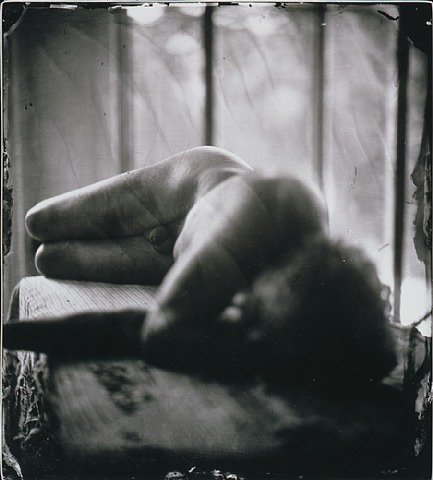
I thought I'd share a few images that caught my eye today. While listening to an interview with Sally Mann, I spent a few minutes researching her series "Proud Flesh". I really love the mystery and vulnerability of these images taken of her husband, who is suffering from muscle dystrophy.

Sunday, February 20, 2011
grandmother's wrinkles
Topographic maps, like wrinkles, map surface contours. In my investigation of topographic maps, I found that early topographers used stereoscopic images of the land's surface to guide their drawings.
Below are a few examples of the stereoscopic pairs I have been working on...


Stay tuned for more to come, including the very beginnings of my handmade stereoscope!
Tuesday, February 1, 2011
the simplicity of winter
During the process of creating and experimenting, I always find myself venturing down new paths. The path I currently find myself on is full of scientific exploration and a lot of trial and error. Amidst these lengthy processes, I have regained the joy of simplicity.


Kodak T-Max 400
Minolta X-700
Saturday, January 22, 2011
ArtWorks for Milwaukee's unique approach to employment
As part of Gallery Night and Day, ArtWorks for Milwaukee unveiled two separate projects created during their Fall 2010 programs, "Positive Influence Project" and "Safe Place Mural". Each project conveyed youth-driven messages, including anti-guns/gangs/drugs, and residents who make a difference.
 Beyond the messages in the art itself, ArtWorks for Milwaukee's mission is to prepare teens to enter Milwaukee's workforce by utilizing the arts to teach employability skills.
ArtWorks for Milwaukee believes...
Keep an eye out for ArtWorks for Milwaukee's upcoming spring and summer projects!
Beyond the messages in the art itself, ArtWorks for Milwaukee's mission is to prepare teens to enter Milwaukee's workforce by utilizing the arts to teach employability skills. ArtWorks for Milwaukee believes...
- Strong employment supports strong communities.
- Underserved teens who develop employability skills contribute to strong communities.
- Utilizing paid internships is an effective way to engage underserved teens and train highly transferable job skills.
 |
| Image Courtesy of 88.9 Radio Milwaukee |
To date, with over 50 successful diverse arts-based programs being completed by over 250 Interns since 2001...
- 75% have gone on to complete high school
- 51% have secured gainful employment
- 23% have successfully applied to other Internship projects through ArtWorks
Keep an eye out for ArtWorks for Milwaukee's upcoming spring and summer projects!
Saturday, January 15, 2011
a few tid bits
Yesterday I met with a friend for coffee. We got into a rather deep conversation about the current state of our careers and our instinctive abilities to take on as much as we can. He is holding four jobs, working on commissioned paintings, managing a successful collaborative blog (Sabu Collective), creating his own work, and somehow still managing a social life. Although we confessed this lifestyle is somewhat unhealthy at times, I know its part of who we are.. organizers, motivators, creative problem-solvers, visual researchers, entrepreneurs, and sometimes, downright crazies.
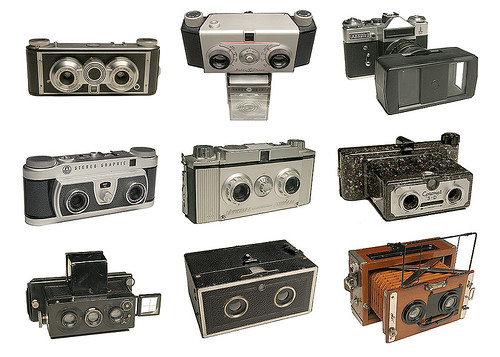
I left the coffee shop feeling motivated to take a step forward with my current work. I purchased two cable releases and began photographing stereoscopically. For those unfamiliar, stereoscopic photography is a technique that simulates 3D vision. Two images are taken of the same object, one from the view of the left eye and the other from the view of the right eye. When viewed through a special viewer, the two images become one 3D image.
Traditional stereoscopic cameras:
My camera set-up:

I left the coffee shop feeling motivated to take a step forward with my current work. I purchased two cable releases and began photographing stereoscopically. For those unfamiliar, stereoscopic photography is a technique that simulates 3D vision. Two images are taken of the same object, one from the view of the left eye and the other from the view of the right eye. When viewed through a special viewer, the two images become one 3D image.
Traditional stereoscopic cameras:
 |
| Image Courtesy of Rick Soloway |
My camera set-up:
Monday, January 10, 2011
World's largest photograph...
The Legacy Project, a non-profit documentary project, is dedicated to producing comprehensive documentation of the shuttered El Toro Marine Corps Air Station. The project, which began in April 2001, will continue over the next decade as the park is created and will employ photographs, video, and oral histories to provide a unique record of an extraordinary development in the history of Southern California.
In the summer of 2006, the six photographic artists of The Legacy Project unveiled the world's largest photograph, The Great Picture. The special reception took place inside the camera that created the world's largest photograph, a gigantic airplane hanger converted into a camera obscura, 44'-2" feet high by 79'-6" feet deep by 161'-6" feet wide. The photograph took 35 minutes to develop!

The Great Picture has been declared the world's largest photograph by The Guinness Book of World Records. It measures three stories high by eleven stories wide and cost $65,000 to produce. The best part about it is that it is, in fact, a silver gelatin print!
In the summer of 2006, the six photographic artists of The Legacy Project unveiled the world's largest photograph, The Great Picture. The special reception took place inside the camera that created the world's largest photograph, a gigantic airplane hanger converted into a camera obscura, 44'-2" feet high by 79'-6" feet deep by 161'-6" feet wide. The photograph took 35 minutes to develop!
The Great Picture has been declared the world's largest photograph by The Guinness Book of World Records. It measures three stories high by eleven stories wide and cost $65,000 to produce. The best part about it is that it is, in fact, a silver gelatin print!
Sunday, January 2, 2011
Kodachrome's last remaining roll developed
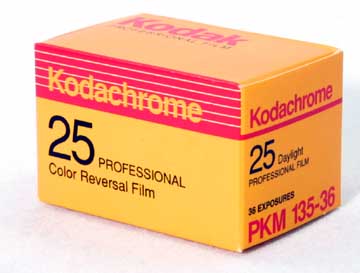
According to BBC News, the last remaining roll of Kodachrome has been developed in Kansas.
Since Kodak announced it was discontinuing Kodachrome, the number of labs that process the film has declined dramatically. Because of its difficult process and required attention, Dwayne's Photo in Kansas was the last remaining lab up until a few days ago.
Check out the full story at: http://www.bbc.co.uk/news/world-us-canada-12095771
A tribute to Kodachrome: http://1000words.kodak.com/post/?id=2388083

Subscribe to:
Posts (Atom)